Using Model Outputs – Coupled Model Intercomparison Project (CMIP)

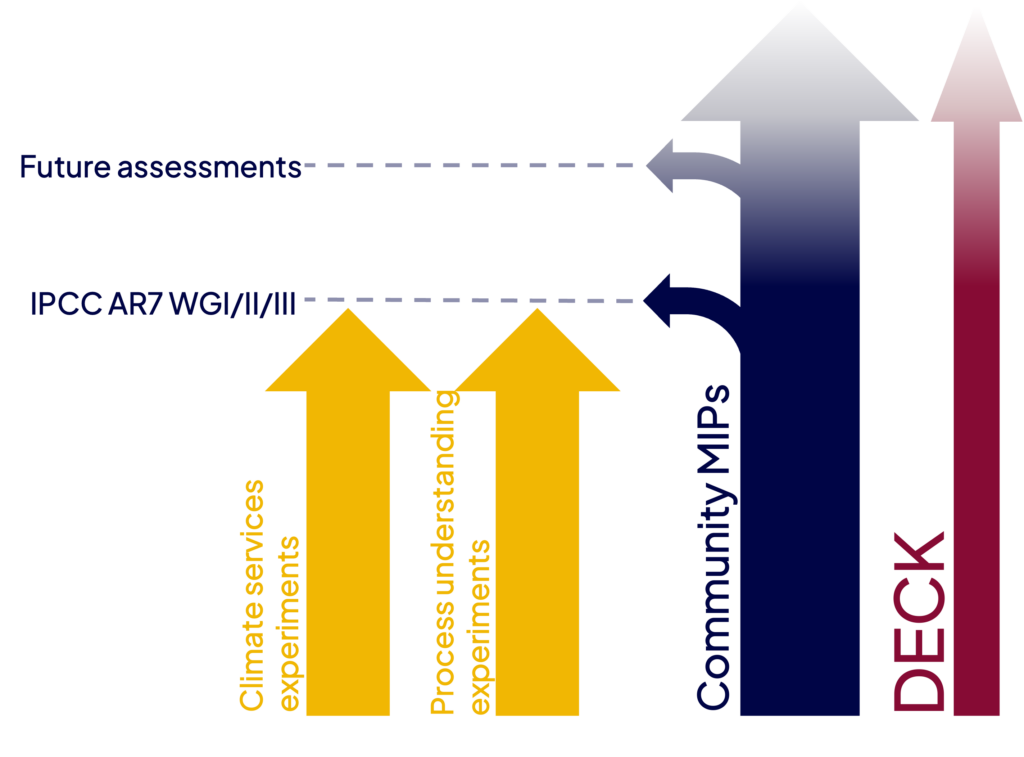
UKESM provides the UK’s Earth System Model contribution to the Coupled Model Intercomparison Project (CMIP) – a project of the World Climate Research Programme (WCRP). CMIP is a global scientific effort where climate research teams from around the world run standardized climate simulations and share their results. These simulations use advanced Earth System Models to explore how the climate has changed in the past, what’s happening now, and what might happen in the future under different scenarios.
CMIP7
UKESM is contributing to CMIP 7 – the next iteration of the international collaboration which is due to produce the first data in 2026 (further details from CMIP are at CMIP Phase 7 (CMIP7) – Coupled Model Intercomparison Project). The UK Met Office will also contribute two resolutions of the latest physical model configuration, HadGEM3-GC5.
Why is CMIP7 Important?
- Global Collaboration: CMIP brings together hundreds of scientists and modeling centers worldwide to ensure consistency and comparability in climate projections.
- Better Climate Predictions: CMIP7 builds on previous phases (like CMIP6) by improving models, adding new processes (such as ice sheets and land use), and using more detailed scenarios.
- Policy and Planning: The results feed directly into major climate assessments, including the IPCC reports, which guide governments and organizations in making informed decisions about climate adaptation and mitigation.
- Understanding Risks: CMIP7 helps answer critical questions like: How fast will sea levels rise? How will extreme weather change? What happens if we overshoot temperature targets?
A co-ordinated UK contribution will be made to the CMIP7 Assessment Fast Track (CMIP7 AFT). The UK will use three models to explore new frontiers in climate processes and resolution, that were not available in CMIP6 models. The models will be identified in CMIP as follows:
UKESM1.3-LL: Based on UKESM1, the ESM model used in CMIP6, with the addition of several process improvements. Resolution ~130 km atmosphere, ~1° ocean. UKESM1.3 is an extension of the CMIP6+ model, UKESM1.1 (Mulcahy et al. 2023) and offers novel, world-leading capability in the form of interactive ice sheet models for Greenland and Antarctica and closed cycles for both carbon dioxide (CO2) and methane (CH4). While a few global ESMs will likely run with emission-driven CO2 in the Fast Track, UKESM1.3 will likely be unique in including the CH4 emission-driven capability.
UKCM2-LL: An atmosphere-ocean model (no interactive biogeochemical cycles or ice sheets), based on the more recent (2024) GC5 coupled model, with parameter tunings that ensure a climate sensitivity < 4°C, well inside the IPCC-assessed likely range. The name UKCM2 replaces the previous informal name “GC5-Central”, and reflects its community nature, with the number 2 chosen because it will become the basis of UKESM2 (expected to be released during 2026). Resolution ~130 km atmosphere, ~1° ocean.
UKCM2a-HH: An atmosphere-ocean model, run at the ground-breaking resolution of ~20km atmosphere, ~1/12° ocean. This resolution is expected to be unique in the CMIP7 Fast Track. The model is again based on GC5, but with some different parametrisation choices including the new CoMorph convection scheme (hence “2a” rather than “2”).
Model runs for the Fast Track need to be completed by late 2026.
Further information on CMIP7 participation can be found at [Newsletter] November 2025 – UK National Climate Science Partnership and [Webinar] CMIP7 – UK Modelling Contribution which provided an overview for the UK climate modelling community of the status of plans for delivery of results from UK models to CMIP7.
UKESM2
The next state-of-art flagship UKESM model will be UKESM2.0. This model is currently under development, and we expect to have a release configuration for use within the community by mid-2026. UKESM2 will be built on GC5-climate and will have several scientific enhancements compared to UKESM1 model, including interactive fire, nitrate aerosol and permafrost. UKESM2 will be run in emission-driven mode for both CO2 and CH4 as standard. We have the ambition to rerun the CMIP7 DECK simulations and a subset of future projections.
CMIP6
The CMIP Phase 6 (CMIP6) was an important application of UKESM models. CMIP6 improved our understanding of, and ability to simulate, key climate phenomena and future climate change using a coordinated multi-model approach. In CMIP6, UKESM1 and other climate models from around the world were integrated using a common set of experiment protocols to address a range of key science questions. CMIP6 contributed to the IPCC Sixth Assessment report.
UKESM1 CMIP6 data sets are available from the Earth System Grid Federation (ESGF) and also from the UK’s Centre for Environmental Data Analysis (CEDA) ESGF at Project Record: WCRP CMIP6: Natural Environment Research Council (NERC) contribution and Project Record: WCRP CMIP6: Met Office Hadley Centre (MOHC) contribution.
The scientific documentation for UKESM1 and its physical model HadGEM3-GC31 is available in the Common Information Model (CIM) metadata format at CMIP ES Documentation.
Licensing of Met Office, NERC and NIWA CMIP6 data sets out the terms of use of this data.